The Handwritten Noticeboard Before the Group Chat
A handwritten noticeboard can turn a vague neighbourhood need into a clear next action, with practical advice on wording, placement, timing and replies.
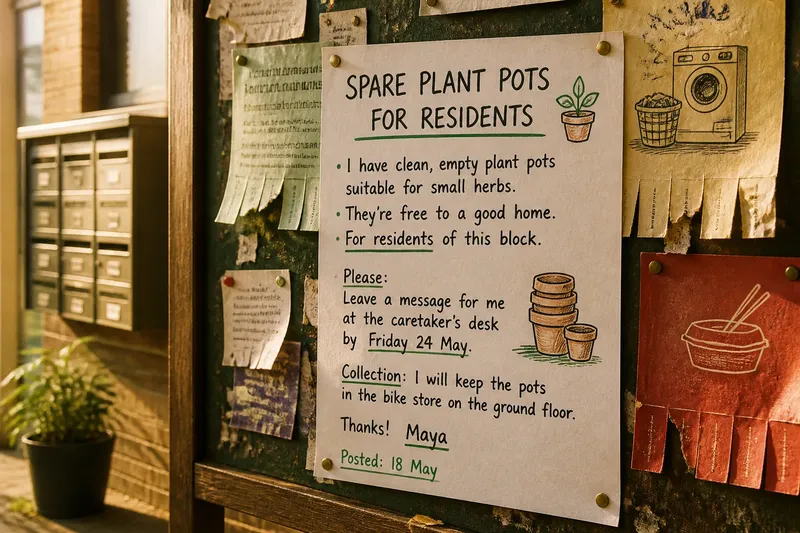
A handwritten noticeboard works best when a neighbour can understand the offer or request while carrying shopping in one hand. Before a group chat existed, the board by a library door, launderette or community hall gave local information a physical address: people saw it during ordinary journeys, not only when they opened a screen. Its usefulness still depends on a simple thing—making the next action obvious.
Imagine that, in a fictional block of flats, several residents have spare plant pots while others are trying to start herbs on narrow balconies. The building has an approved noticeboard in its entrance, but it is crowded with old flyers and a faded takeaway menu. The residents decide to use the board to match spare pots with people who can use them. This is not a grand campaign; it is a small test of how local information travels from paper to action.
Why does a noticeboard still reach people?
A noticeboard meets residents where they already pause: beside the postboxes, near the library returns slot or in the entrance to a shared hall. A person who does not use the same messaging app as a neighbour can still see a note while checking the day’s post. The board also gives information a local boundary; a notice in a block is plainly meant for people who pass through that block.
That physical setting carries useful context. A reader can see whether a note belongs to a housing association, a residents’ group or an individual, and can decide whether it applies to them. Unlike a fast-moving chat thread, a paper notice remains in view until someone removes it, so a well-dated note can keep working between visits.
But the board is not automatically inclusive or reliable. A notice hidden behind a cluster of old papers, written in cramped handwriting or left without a contact route can fail even if the offer is useful. The board is a shared surface, much like a kitchen table: it works for everyone only if each person leaves room for the next.
What happened in the residents’ noticeboard situation?
In the imagined block, Maya has a stack of clean, empty pots after repotting plants. She asks the caretaker whether the entrance board is available for a small community notice and learns which part of it residents may use. The board is not a place for notices about building repairs or emergency information; those remain with the people responsible for them.
Maya’s first draft says, “Free pots—take some!” It is friendly, but it leaves important questions hanging. Are the pots outside the building? Are they all the same size? Should someone take them from a shared area, or contact her first? The residents revise the note before posting it, treating those details as part of the offer rather than as fine print.
The final note says that a resident has clean plant pots to give away, describes them as suitable for small herbs, and asks interested neighbours to leave a message with the caretaker by a named day. It gives a first name and a safe contact route, says where the pots will be kept, and includes the date it was posted. The caretaker agrees to pass messages on, so Maya does not need to publish her flat number or personal phone details.
After the note goes up, a neighbour leaves a message asking for two pots. Maya sets aside the requested items and updates the notice to say that some are spoken for, while others remain. When the remaining pots have found takers, she removes the paper rather than letting an expired offer linger. In this invented situation, the result is not simply that objects change hands: the notice makes the exchange legible, manageable and limited to people who share the building.
What makes a handwritten notice easy to act on?
A useful notice answers the reader’s immediate questions in a sensible order. Start with the thing that matters most—what is being offered, requested or arranged—then explain who it is for, where it applies and what the reader should do next. Keep the writing large enough to read at a normal standing distance, and leave clear space around the words.
- Lead with a specific heading: “Spare plant pots for residents” tells a passer-by more than “Free stuff”.
- Describe the offer plainly: Say whether the pots are clean, empty and available to take, rather than expecting readers to infer their condition.
- Name the intended audience: “For residents of this block” prevents confusion about who may respond.
- Give one clear next action: Ask readers to leave a message with the caretaker, collect from an agreed place or speak to a named organiser.
- Make the contact route workable: A first name and a building-approved contact point may be enough. Do not publish someone else’s details without permission.
- Include a date or closing point: Readers need to know whether the offer is current; the organiser needs a prompt to review or remove it.
- Make the page readable: Use dark ink on plain paper, a clear hand and short lines. Avoid decorative lettering that slows the reader down.
For a request rather than an offer, be just as precise. “Can anyone help?” asks the reader to work out what is needed. “Could a resident lend a small watering can for the shared balcony garden? Please leave a note for Sam at the caretaker’s desk” gives them a concrete choice.
How should the notice change from first draft to result?
The imagined exchange shows why a notice is not finished when it is pinned up. A board is a small, slow conversation: the organiser puts out a clear message, readers respond through the route provided, and the organiser updates the page so the next person sees the current position.
Suppose Maya had simply written “Take some” and left the pots beside the postboxes. A resident might assume the items were rubbish, while another might take the entire stack. By stating the collection arrangement and inviting a reply first, she makes the intended use visible without policing how neighbours behave.
As responses arrive, a brief update can prevent duplicated effort. “Two pots reserved; more available” is more helpful than a second, nearly identical notice. If the offer ends, remove the paper promptly. A clean patch of board tells the next organiser that the space is available, and it spares readers from acting on information that no longer applies.
Which questions do neighbours ask about local notices?
What information should a community notice include?
Include the subject, intended audience, place or area, a clear next action and a date. Add a contact method that the organiser has agreed to use, and explain any condition that would change a reader’s decision, such as whether an item needs collecting.
How long should a notice stay on a shared board?
Keep it up only while it is useful, and give it a review or end date so someone remembers to check. Remove it when the offer closes, the event passes or the contact route stops working.
What if the noticeboard is already full?
Ask the person or organisation responsible for the board how notices are managed rather than covering existing information or removing someone else’s paper. They may have a space for resident notices, a rotation system or another local place to display them.
How can someone reply without sharing private details?
Use a shared contact point, such as a caretaker, library desk or community organisation, if that arrangement is available and agreed. A note can invite a first name or a brief message without displaying a home address or personal number to everyone passing by.
Where should the board fit into local information?
Not every message belongs on paper. A noticeboard suits information that is local, non-urgent and useful to people who pass that particular place: a swap, a community meal, a request for a borrowed item or a change to a residents’ gathering. A time-sensitive building issue, private matter or safety concern needs the appropriate direct channel instead of a public notice.
It also helps to think about who may not pass the board. A person who works different hours, has limited mobility or does not use the building entrance may miss the message. If the offer matters beyond the people who walk past, the organiser can ask a local library, community centre or residents’ association whether another suitable route is available. The paper notice can remain one part of the exchange rather than pretending to reach everyone.
For the residents with spare pots, the handwritten noticeboard did its quiet job because the message matched the place: a small, practical offer for neighbours who shared the entrance. The same principle makes any local notice easier to use—say what is available, tell people how to respond, and clear the board when the answer has arrived. A useful notice does not need to sound polished; it needs to leave the next neighbour with no guesswork about what to do.